
HBCU Initiative: The Black Brown Gap in the Blue Zone
By Dianne Anderson
On one side, San Bernardino County may be a great place to live, and home of some of the longest living people in the country in the famous Blue Zone area of Loma Linda.
On the other side, Black and Brown families are sicker and dying more than most other places in the state and nation, and the big question is not so much why the stark difference, but how to get beyond the food desert.
Like most things health related, some people are working overtime to try to pay rent and put top ramen on the table.
It could be more a matter of money.
In Loma Linda 92354, the food is great, nutritious, and affordable for their median household income at about $82,000, which also helps the mostly vegetarian community there to live long.
But in 92410, Black and Brown families die 11-20 years before Loma Linda’s Blue Zone centenarians, trapped by $45,000 incomes, close to trucking and railyard fumes, and fast food drive-thrus.
Health advocates hope to change the dire statistics.
Dr. Juan Carlos Belliard said through a five-year HEART Initiative, led by the Meharry School of Global Health, they want to replicate a model of longevity. San Bernardino is the first launch city for the initiative, with Detroit and Nashville expected to follow later this year.
He said it is critical to work closely with community and city officials, starting with the built environment, career pathways, and education.
“By bringing folks together we can all advocate for policy that can address these food deserts and food swamps,” said Dr. Belliard, PhD, Assistant Vice President for Community Partnerships at Loma Linda University Health.
As part of preventive, community-focused care, Loma Linda University Health and IEHP are training medical students and cardiology fellows. UCLA fellow Dr. Christoff Foster, an LLU graduate, and Dr. Columbus and Mrs. Danette Batiste of Healthy Heart Nation of the Healthy Heart Foundation are also partners advancing the local initiative’s heart health goals.
Right now, about 400 families receive free fresh food every other Friday at San Bernardino’s community gardens, while visiting Meharry students learn about food access and youth career pathways through LLUH’s CAPS program.
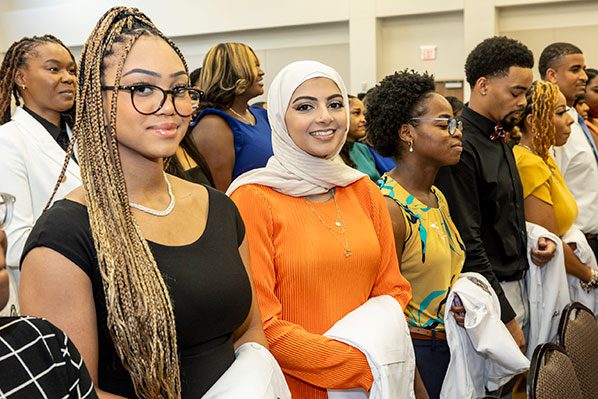
Meharry students whitecoat ceremony
He said the community garden is tackling food insecurity and building community.
“San Bernardino has an overrepresentation of fast food in low income communities and communities of color, it makes it very difficult for a working parent to pass up that drive-thru where you can get a lot of calories for the least amount of money,” he said.
He is excited to see signs of progress.
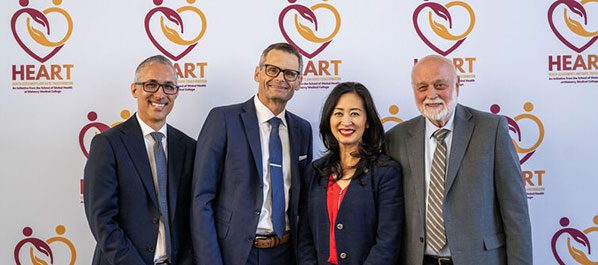
Looking over a recent picture of top medical leaders, he appreciates those credited with breaking new ground in the medical field, including Dr. Underwood, Dr. Hart, Daniel Dawes, and Dr. Roger Mitchell.
All are critical to the past and future of how the Black community moves forward.
“I think that picture says so much, less related to the heart than the history of Black physicians in our country. The reason why we have an NMA is because of Jim Crow, and now we have an African American President-elect of the AMA all working together on this initiative. That picture really struck me,” he said.
With participation from Regina Benjamin, former Surgeon General, and Georges Benjamin, CEO of the American Public Health Association, he expects good things to come.
“We’re going to be able to tap into tremendous wisdom and experience with this National Advisory Council, and really take a lot of lessons learned and history from all these individuals and apply it to our local context,” he said.
Daniel Dawes of Meharry is also working with Loma Linda, Corewell Health, Meharry, Novartis, and others, said the initiative builds partnerships where doctors and community leaders learn from each other, and health equity happens at the clinical, community, structural and policy levels.

But he said the most powerful prescription in America isn’t written by a doctor, it’s written by a politician.
Growing up, Dawes said his parents didn’t realize how much sugar is in soft drinks. Now, prediabetic with high blood pressure, he works hard to keep his health under control.
But his background also guides his work on preventable community health issues.
“What motivated me to start this project is those experiences, at our church, with our parents and others who didn’t know they had high blood pressure and caught it too late. Or, had high cholesterol and had been eating foods that contributed to blockages in their arteries,” he said.
There are also severe blockages in the health system that date back more than a century.
Systemic racism in American medicine following the 1910 Abraham Flexner report led to the closure of five of the seven remaining Historically Black medical schools, leaving only two HBCU medical schools, Meharry and Howard University School of Medicine.
He said Meharry’s 150-year legacy, founded after the Civil War, has produced most of the nation’s Black physicians and culturally competent providers.
Locally, their mission is to reverse health inequality and keep the trust of the Black community.
“When you think about different experiments done in this country, the Tuskegee syphilis study, Henrietta Lacks, and so forth. You’ll never hear Meharry’s name in any of these,” said Dawes, J.D., founding dean of Meharry’s School of Global Health.
Even though change is slow, he said their plan lays good steps for near, medium, and long term impact.
At the federal level, one bright spot is that agencies like CMS and HHS are showing bipartisan interest. With that, he hopes to work with policy makers to create payment models that help older adults and low-income communities with a self-sustaining system that lasts beyond five years.
Lack of Black doctors is another major concern that he continues to fight at all levels, within academic medicine and across the country to prioritize admission of Black students into their programs.
“We’re trying to diversify the physician workforce in California, to bring more Black doctors. I’m trying to figure out a way to bring all HBCUs into this,” said Dawes, who is also co-chair of a California medical advocacy group.
Dawes, a recognized authority on the political determinants of health, studies how resources and politics shape health from birth to death.
It’s not enough to just understand social drivers and health inequity challenges, but underlying policy is key, especially in areas of food, housing, transportation and education, he said. He also wants to push for bundled payments through Medi-Cal to make healthy foods more affordable and accessible.
Much of the nation’s health disparities are driven by heart disease, often overlapping with mental health conditions. Low income people of color use urgent care more often, and the costs are huge, with combined direct and indirect costs that could top $1 trillion over the next five years.
He said what it comes down to is a “food as medicine” approach, and keeping people out of the hospitals.
“I would love for folks not to have to go to Loma Linda Hospital or Corewell Health or Meharry because we are preventing their cardiovascular disease from escalating to the point where they have to seek emergency or urgent care services,” he said.
For more information:
1.) For LLU, see https://llu.edu/campus-spiritual-life/mission-outreach/community-academic-partners-service-caps
2.) For IEHP https://www.iehp.org/
3.) To see Meharry Medical College, one of the nation’s oldest historically Black academic health sciences centers, https://meharry.edu/meet-meharry/history/
