
‘Don’t Let Anything Slide’: CA Commissioners Urge Reporting Hate
By Selen Ozturk
Three million Californians — nearly one in ten adults and teenagers statewide — experienced at least one hate act in one year, according to new survey data.
But the commissioners and researchers who presented those numbers at this year’s California Civil Rights Summit in San Francisco said the true scale of hate in the state is almost certainly far worse. Law enforcement data, they noted, captures only about 3% of actual hate crime victimizations, as approximately 42% of even violent hate crimes are never reported to the police.
FBI data presented at the summit show hate crimes running at their highest levels in 34 years.
The survey findings were presented one week before two teenage gunmen killed three people at the Islamic Center of San Diego on Monday, May 18. Police are investigating the shooting as a possible hate crime, with investigators having found possible anti-Islamic writings in the suspects’ car.
The mosque’s imam called the attack, which came during one of the holiest periods of the Islamic calendar “outrageous.” He said it reflected a national pattern of religious intolerance that has been building for years.
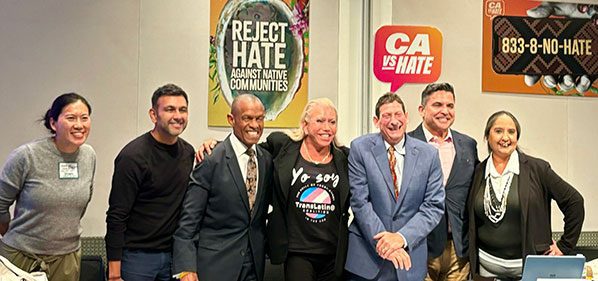
The figures of hate experienced in 2024 were among the findings shared at a May 11 afternoon public forum hosted by CA vs. Hate, in partnership with the California Commission on the State of Hate and Stop the Hate, held at the Commonwealth Club as part of the all-day summit.
The panel, titled “Combating Hate,” brought together commissioners, state researchers and community members to present the commission’s latest data, training resources and prevention recommendations, and to hear directly from the public about where gaps remain.
The commission, created by the California Civil Rights Department (CRD) in 2021, has since issued 42 recommended methods to monitor, prevent and respond to hate acts across California and partnered with UCLA to build what Commissioner Russell Roybal described as “one of the most comprehensive data sets on hate in California to date.”
The survey data is available through the UCLA Center for Health Policy Research’s “AskCHIS” dashboard, with data aggregated by county, demographic group and year.
What the data shows
San Francisco’s rate of 12.8% of residents experiencing hate — above the statewide average of 9.4% — was among the county comparisons highlighted by CRD research staff member Dr. Adrian Bacong.
The two most common needs cited by Californians who experienced a hate act are mental health support at roughly 38%, and help with physical safety at 23%.
Working with law enforcement, the data shows, ranks slightly lower at 22% — partly a reflection, said Bacong, of the distrust many communities have toward police.
Race and skin color are the most commonly cited reason people believe they were targeted, accounting for 55% of hate acts experienced. Ancestry, national origin or language is the second most common at 21%, and sexual orientation or gender identity follows closely behind at 17%.
Within law enforcement data — which Bacong noted skews differently — anti-Black hate crimes rank highest by racial and ethnic group.
One piece of the commission’s work addresses what happens when someone does try to report. As part of its investigation into law enforcement responses to hate, the commission spoke with 53 people across California about their experiences, and noted consistently low expectations of help.
“I do feel like sometimes I can’t seek help just because of my race from authorities,” one respondent said.
Another described reporting a hate incident only to be told by officers, “Sorry, this happened to you, but we can’t help you.”
A third chose not to report at all, explaining they hadn’t been physically harmed and didn’t expect much to come of it.

Dr. Rebecca Goodsell, a CRD researcher who led that work, said “for some, the experience of hate may be so normalized that they may not think that it’s a big enough deal to report it,” but even “acts of hate that are not crimes cause harm to people and communities, and they need responses.”
‘These numbers don’t capture it all’
A CRD colleague, Dr. Kevin Thomas, presented another major area of the department’s research: evidence-based prevention. He focused on two areas — improving school climate and public messaging.
Adolescent respondents to the 2024 survey aged 12 to 17 were more than twice as likely as adults to have witnessed hate in the past year — 35% versus 17% — while 83% of adolescents who experienced hate encountered it at school.
Thomas advocated for an intervention model “where we’re thinking about the entirety of the community and not just the school as a singular thing.” He also pushed for shifting the focus of hate response from survivors bearing the burden to holding perpetrators accountable in non-punitive ways.
Commission chair, civil rights attorney and criminologist Brian Levin shared what he called preliminary FBI data “hot off the press.” While hate incidents in 2024 were 1.5% lower than a spike of 11,862 incidents the previous year, hate crimes in this decade overall are running at the highest levels in 34 years, since the FBI began collecting data.
Levin flagged a sharp rise in anti-transgender hate crimes on the national level in the past few years coinciding with an explosion of anti-transgender legislation, and an even more recent record high for anti-Latino hate crimes in California — up 18% from 858 incidents in 2024 to 1,014 incidents in 2025.
“Don’t think just because these numbers have gone down a bit off a record just a couple years ago” that the problem is easing, Levin said, pointing to the migration of hate activity “online in an un-guardrailed social media landscape.”
“I am also concerned, though these numbers don’t capture it all,” he added, emphasizing a “90%, 95%” gap between what official hate crime data shows and what surveys like CHIS capture.
From retribution to education
Commissioner Regina Cuellar shared a story of what addressing these gaps can look like on the ground.
A Miwok community member in El Dorado County shopping for a car recorded a car dealership employee after a call didn’t hang up properly: “He thought he hung up the phone on her. He did not hang up the phone. He was still on the line, and she was on the line listening to him making racial comments and basically saying, ‘Oh, what is she going to pay for this, with acorns and feathers?’” Cuellar described.
The woman used the CA vs Hate hotline, was connected to support service and ultimately saw the dealership brought into her community rather than fined.
“My community educated them about our history, the trauma, the resilience of my people, what California had done to our native communities,” said Cuellar. “A lot of those staff walked away like, ‘Thank you so much for doing this. Now I understand what those words mean and how they hurt.’”
“The system of justice that we are in is largely centered around retribution and punishment,” said commissioner and civil rights attorney Ehsan Zaffar. “How rare is it for somebody who allegedly commits a crime and may even be convicted of a crime to actually face their accuser and apologize?”
“As someone who grew up in the civil rights era, I thought we had moved forward, and I think things are equally as bad, if not worse,” said commissioner Dr. Erroll Southers. He added, “These incidents do not have to rise to the level of a crime to be reported,” and that a pattern of non-criminal hate incident reports may build toward a prosecutable case.
Permanent funding
While the CRD Commission on the State of Hate is currently funded to track and prevent hate in California through 2031, no permanent infrastructure exists to continue state data collection beyond that.
One of the commission’s core recommendations is establishing an ongoing funding stream to make preventing hate a permanent part of California’s civil rights infrastructure.
Annie Lee, managing policy director at Chinese for Affirmative Action, tied the data to the current federal moment.
“We cannot talk about hate today in 2026 without acknowledging the larger federal context,” she said, describing what she called “a trifecta of hate” — political rhetoric, policy changes at immigration and education agencies and the hate acts people experience on the street. “Those three are all connected, and they feed each other.”
