
State of Black CA: Leaders Convene to Confront Crisis
By Joe W. Bowers Jr.
California Black Media
New data showing rising unemployment and widening economic gaps for Black Californians framed a statewide conference at UCLA, where more than 200 advocates, policymakers, elected officials, scholars, entertainers and community leaders gathered to examine the conditions facing Black Californians and to push solutions for a thriving Black California.
Hosted by the UCLA Ralph J. Bunche Center for African American Studies in partnership with the California Legislative Black Caucus (CLBC), the “State of Black California” conference focused on collecting and confronting data on the condition of Black Californians and connecting it to community experience, policy and political power.
Dr. Michael Stoll, UCLA professor and faculty director of the Black Policy Project, reported that Black unemployment rose from 5.6% to 7.5%, adding roughly 25,000 unemployed workers — the largest increase among racial groups.
The rise was most pronounced among Black women, including those with college degrees — a pattern that highlights why the issue is particularly urgent, as the California Black Women’s Collective Empowerment Institute (CABWCEI) reports that Black women are the primary earners in about 80% of Black households statewide.
The data also showed rising involuntary part-time work and a growing number of individuals disconnected from both employment and education. Stoll pointed to the erosion of public sector jobs — long a pathway to stable, middle-class employment — as a key factor reshaping opportunity.
The conference opened with community leaders who connected those findings to lived experience.
Dr. Brandon Nicholson, chief executive officer of The Hidden Genius Project, called for stronger investments in Black youth and clearer pathways into technology and leadership.
Mina Anochie, research and policy fellow at Altadena Rising, described ongoing gaps in disaster recovery following the Eaton Fire, including families who still had not been contacted by relief agencies.
Dr. Rhianna Rogers, senior vice president of research and programs at the California Black Women’s Collective Empowerment Institute, pointed to the economic pressures facing Black women, who often serve as primary breadwinners while facing wage gaps and higher poverty rates.
Los Angeles Mayor Karen Bass, in a prerecorded message, and Assemblymember Isaac Bryan (D-Ladera Heights), CLBC vice chair, connected the purpose of the conference to public policy.
Bass called it “one of the most important convenings of Black leadership in California.” In his remarks Bryan emphasized the need to move from data to outcomes, connecting the research to legislative priorities.
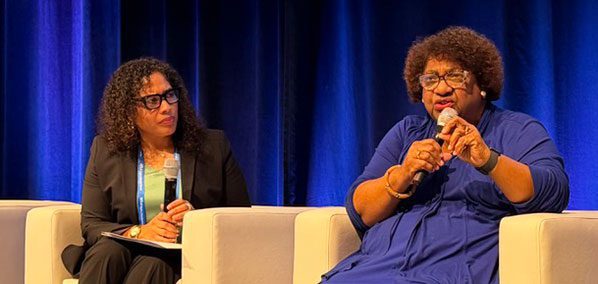
In a fireside chat with Dr. Lorrie Frasure, director of the Bunche Center, Secretary of State Shirley N. Weber tied political power directly to participation and warned that forces outside California continue to shape local access and influence.
“If you don’t vote, you are allowing someone else to determine your future,” Weber said, urging attendees to use their “juice” — their individual influence — to push back against misinformation and policies coming out of Washington that affect Black communities.
Next, the panel “Pathways to Success: Education, Artificial Intelligence and Opportunity in California,” turned to the future and the question of who will shape it.
Participants included Assemblymember Dr. LaShae Sharp-Collins (D-San Diego), singer and activist Aloe Blacc, senior UCLA researcher Dr. Tiera Tannkley and moderator Dr. Safiya Noble, professor at UCLA.
Sharp-Collins framed the issue in terms of accountability and leadership. She said, “There is a difference between leading Blacks and Black leaders.”
She also raised concerns about the use of new technology in schools, asking, “Why are we experimenting on Black kids?”
“Blackness is codified as failure,” Tannkley said, warning that data-driven systems can reinforce bias.
Noble raised broader concerns about artificial intelligence, while Aloe Blacc emphasized the need to align education, visible opportunities and attainable jobs.
Sharp-Collins also made the case for belief and investment, saying, “It’s going to take someone to believe that all students can achieve.”
The panel on, “Affordability & Stability: Building Thriving Black Communities,” focused on the widening gap between wages and the cost of living.
Panelists included Kevin Harbour, chief executive officer of BizFed Institute; William McGee, California deputy superintendent of public instruction; Sen. Laura Richardson (D-Inglewood); and moderator Dr. Jasmine Hill, assistant professor at UCLA.
Harbour defined the issue in direct terms: “Affordability is the ability to have your income exceed your expenses.”
As the discussion shifted from education to job outcomes, McGee pointed to a structural gap between credentials and stability.
“Credentials just to end up in low wage work,” McGee said, describing how for Black workers completing school does not guarantee access to jobs with wages, benefits or long-term security.
Richardson linked economic mobility to policy choices, warning, “When you stop DEI… the door is closed.”
Harbour also pushed ownership as a strategy for long-term stability, saying, “Getting a job is cool. Getting a business is better.”
The closing panel, “Culture as Power: Art, Voice, and the Fight for Black Futures,” shifted the focus from conditions to power — who defines the narrative and who benefits from it.
The panel featured Bryan, Assemblymember Sade Elhawary (D-Los Angeles), Rock and Roll Hall of Famer, activist & author Chuck D and moderator Dr. Gaye Theresa Johnson, professor at UC Santa Barbara.
Bryan grounded the discussion in community experience, saying, “Real change comes from the people who have been most impacted.”
Chuck D tied culture directly to political struggle. “A federal administration… is actively trying to erase our culture,” he said. He also warned against mistaking digital activity for movement building, saying, “Social media is not our space for movement and change.”
Elhawary pointed to the importance of representation and access to policymaking, while Johnson framed culture as central to how policy is shaped and understood.
Throughout the conference, UCLA leaders, including Frasure and Executive Vice Chancellor and Provost Dr. Darnell Hunt, stressed the university’s role in producing data that can inform public policy.
Members of the Legislative Black Caucus, including Bryan, Elhawary, Sharp-Collins and Richardson, pointed to the need to turn those findings into concrete policy solutions.
“You cannot develop policy if you don’t know the condition of the people,” Bass said.
