
S.B. Mayoral Candidate Amy Malone
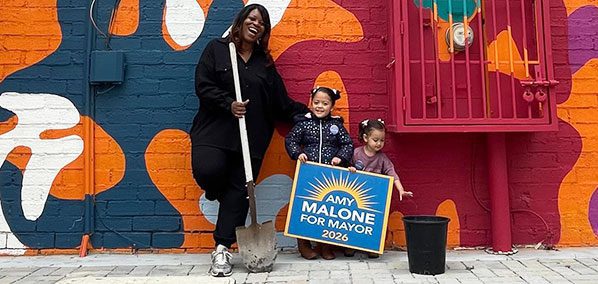
By Dianne Anderson
With the Primary Election only a few weeks away, Amy Malone is looking at both sides of the streets of San Bernardino, where, on one side, she sees the proliferation of homelessness. On the other, vacant boarded-up buildings could be recycled into housing for the homeless.
Not long ago, she met a woman with three younger children in a parking lot, made homeless by high rent, even though the mother works at minimum wage. The mom had contacted a major homeless nonprofit provider that placed them in a unit, but her voucher was up, and she didn’t have the money to pay until the next voucher.
“So I give her some numbers, and I told her I could at least take care of one night. I drove to the hotel. All of her stuff, their clothes and bags, are in the parking lot. The children are just kind of playing in the parking lot. Where does she go from here? This is a reality,” she said.
San Bernardino County continues to be one of California’s hardest-hit regions for homelessness. At last count, despite a 3% decline, the 2026 Point-in-Time Count recorded 3,718 unhoused individuals. But, the City of San Bernardino accounts for nearly a third at 1,442, the highest in the county. Statewide, homelessness rose 26% from 2021 to 2024, according to the Public Policy Institute of California.
Next door to a supply of underutilized buildings, she sees more and more moms and children and elderly becoming homeless as many commercial buildings are boarded up with locked doors.
People are trying to get inside.
“It’s bad because the mall [area] is now just empty space. We have buildings that are boarded up that are burning down because they’re being occupied by our unhoused right now. Why are we not regulating that? Why are we not taking control?” she said.
She points to one solution that has had good success across the country.
One 2024 National Bureau of Economic Research study found that 11 percent of downtown office buildings in the nation’s 105 largest cities are suitable for residential conversion and could provide an estimated 400,000 apartments nationwide.
She said the city council is always talking about receiving $200 million for this or that project or program, but no one ever sees where the money is going.
Malone’s Accountability First plan includes public dashboards to show who gets city contracts and why, plus quarterly budget town halls.
“Transparency is not a slogan for me. It is the single biggest reform we can deliver,” she said.
Converting vacant buildings into housing is safer than sleeping on the streets.
Malone envisions that properties could feature commercial at the ground floor level, and converting upper floors to housing, called mixed-use or adaptive reuse. It would allow older office buildings to have storefronts, restaurants, or office space at street level while adding apartments above.
“Every door I knock and every conversation I have, they want to feel safe in their homes, on their blocks, walking their kids to school. They want improved infrastructure, paved streets, working streetlights, and public amenities. They want affordable housing and homelessness addressed,” she said.

Los Angeles adaptive reuse goals have turned older commercial buildings into housing and kept street-level retail intact, repurposing over 12,000 units in Downtown LA since 1999. Earlier this year, they expanded the program citywide, allowing buildings as new as 15 years old to be converted, that will lower costs compared to new construction. Chicago has used similar incentives to bring vacant buildings back into use as housing.
In Malone’s proposed “Never Alone Housing Initiative,” she hopes for partnerships with faith and nonprofit groups to expand transitional housing, quickly using underutilized buildings, dormitories, and parsonages, with the city providing services and security.
On the street, she is talking to small business owners frustrated that they are being turned away for permits. Neglected properties are also tied to blight. City code allows fines up to $1,000 per day for neglected or abandoned properties and authorizes the city to complete repairs and recover costs, but records show limited enforcement capacity tied to a small registered rental base.
“We can have mixed space, where you have houses at the top and then we have retail at the bottom. We can bring in dining and we can bring in entertainment. There’s so much that can be used in that space now, but we’re not using it. It’s just empty.”
One of the things she loves about the city is that when she talks to the community, the people have pride. It’s a big city, but a small-town feel.
“Many of the residents have grown up here all their lives. They’ve gone to school here and their family is here. That is what I have found,” she said. “It has really declined. It was an All-American city, and now we are the butt of people’s jokes.”
Bringing San Bernardino up can start with small steps to improve community morale, she said, getting funding from absentee landlords to help spruce up the community. “It’s grass. It’s trees. It’s things that we can do. Paint and foliage. You put some greenery someplace, and guess what? It looks totally different. And then people feel different. The residents feel different.”
For any naysayers that emphasize she hasn’t lived very long in San Bernardino, she said that people have lived in the city all their lives, and things are still in bad shape.
“You have had people sit in that office that have lived in San Bernardino all their lives, and we are still in the situation that we’re in,” she said. “You don’t have to live here to want change.”
Malone, founder of Girl in Charge PR and president of the NCNW Inland Empire Section, says doubling down on existing relationships rather than building from scratch is key to her housing plan. In March, she also held the Inland Empire State of Women Summit at San Bernardino Valley College
“For more than 30 years, my job has been to take complex situations, build the right team, set a clear plan, and execute it from inception to completion. That is exactly what San Bernardino needs,” she said.
To see:
Ms. Malone’s platform: https://amymalone4mayor.com/
Early voting places started Monday, May 4. See https://elections.sbcounty.gov/elections/2026/0602/
The Adaptive Reuse Map https://www.housingisahumanright.org/adaptive-reuse-map/
