
$5K HBCU Grants, Apply Now or Miss Out
By Dianne Anderson
Use it or lose it, like the old saying goes, is especially true for hard funding deadlines, but things are much easier these days than when Ruben Page started his journey in 1999.
Back then, before the California Community Colleges to HBCU Transfer Guarantee program existed, the process was grueling.
“They all would have different websites to apply, there was no guarantee to get into an HBCU, they didn’t have the HBCU caravan,” Page said, adding that today, students can get in the door of about 30 to 35 participating HBCUs with only one streamlined application.
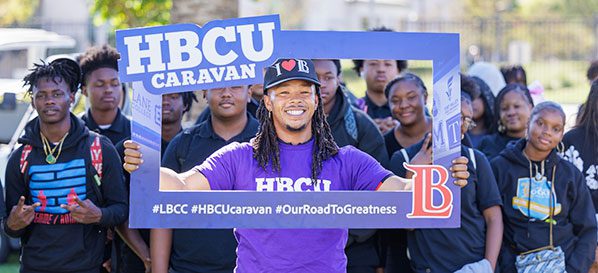
Page, Long Beach City College Transfer Center Coordinator, said the campus’s most recent HBCU caravan drew a strong turnout that shows interest is high, but community college students that haven’t applied yet need to act now.
Student success for those attending HBCUs is at the top of their game, including strong alumni support.
The California Community Colleges Chancellor’s Office reports that HBCUs, which comprise just 3% of U.S. colleges, graduate 20% of all Black students. They have produced 40% of Black engineers, 50% of Black lawyers and 50% of Black doctors, according to the Thurgood Marshall College Fund.
“It’s one of the benefits of HBCUs, along with a close-knit supportive community. Academic excellence has been measured. Now students are also getting a sense of cultural empowerment and representation, that’s really popular with our students, as well as the traditions the HBCUs have,” he said.
For those who move fast, community college students can access the $5,000 Cal-HBCU Transfer Grant with guaranteed paths to dozens of schools, if they meet the March 2 priority FAFSA deadline.
Late filers that wait until September will lose those HBCU slots.
The other big issue is that while the standard Cal Grants cover classes at California community colleges, they won’t fund a move to an HBCU. To get the Transfer Entitlement Award, which follows students out of state, they must meet that March 2 priority deadline.
Local veteran Charles Barnes has chaperoned HBCU events at Long Beach Unified School District, where his daughter went straight from high school into Howard University. It was a great cultural experience, but if only he had known the obstacles ahead.
He has been looking for the money to keep the dream alive.
For now, he said she’s taking a gap semester at CSULB online because she hasn’t been able to get the funds to continue at Howard. And, information on how to make the system work has been extremely limited.
Although she loves it there, like a lot of people, he lives in a gray area where he can’t afford to come multi-thousands out of pocket, but also is not able to find extra help. At one point, he received a scary bill.
Now that she’s back in California for a gap semester, he said she should be getting the CalVet College Fee Waiver at CSULB, but navigating those benefits on top of her unpaid Howard balance has been confusing.
Barnes said the process has been a deep and winding rabbit hole.
“I didn’t know it was going to be as hard as it was to get scholarships or funding for my daughter, I thought she would do well in school and the funding would roll in, but it didn’t happen that way,” he said.
Admission to HBCUs isn’t the problem. It’s the funding.
Feb. 5 ended the “Regular Decision” for some top HBCUs, but many schools keep accepting students through July. But, California cuts off out-of-state funding on March 2, so students can get accepted to an HBCU, but still have no way to pay for it.
University students also do not have access to the $5,000 grant that is only for community college students. If university students miss the deadline, it means losing the Cal Grant entirely, making attending an HBCU impossible for those who need the money.
In other words, don’t wait.
He wishes there was more support for HBCUs, not only getting in the door. He said that his daughter had other friends that also wanted to go to other HBCUs, but chose not to because of the financial obstacles.
“Students need to have a good sense of advocacy,” he said. “You have to be a squeaky wheel to get them to act on your behalf.”
Given what his daughter is going through, he said these days he would advise high school students that want to go to learn how to get the money.
For that reason, one workaround may be the National Student Exchange, or “Study Away.” Students stay enrolled at their CSU while attending an HBCU, using the “home payment” model to keep their Cal Grant.
Available at CSU campuses including Northridge, Monterey Bay, and San Bernardino, the program lets students remain enrolled at their Home campus. The ‘Home Pay’ model preserves Cal Grant eligibility and in-state tuition while they spend a semester or year at a participating HBCU.
Although the $5,000 Cal-HBCU Transfer Grant serves community college transfers, CSU students can also tap UNCF scholarships and Howard’s merit awards. They are encouraged to contact the campus study abroad office as NSE priority spots for Fall 2026 are filling fast, with most priority deadlines falling between Feb. 13 and Feb. 20.
For students like Barnes’ daughter, advocacy also means jumping through several hoops.
Because CSU Long Beach runs independent exchange programs, students must apply directly through the campus Center for International Education by the March 9 deadline. This ‘Home Pay’ model keeps the student enrolled at CSULB while attending Howard, preserving California aid and allowing the CalVet College Fee Waiver to cover tuition, provided the March 2 FAFSA deadline is met.
Most of all, Barnes feels a lot hinges on how much the student values the experience of being at a campus that is predominantly Black.
“If that’s important to you, it’s invaluable, if you can afford it, and find a way to fund it through scholarships or grants. My daughter loves it, for her it was worth staying there even though it is so expensive,” he said.
For help with applications and funding, see:
For The March 2 Deadline for $5,000 HBCU Grant, see https://www.csac.ca.gov/cal-hbcu-transfer-grant-program and csac.ca.gov/apply
For an HBCU Workaround and Home Pay model see, The NSE at nse.org/campuses
For the Veteran DVS-40 Benefit, see calvet.ca.gov/college-fee-waiver
For FAFSA, see https://studentaid.gov/h/apply-for-aid/fafsa
