
New Funding for Doulas, Black Moms & Babies Die More
By Dianne Anderson
Numbers and action speak louder than words, which explains why Black mothers and babies are still dying at over three to four times the rate of white women, and the data has hardly budged for decades.
Maybe some new money trickling down from the state to the counties can help.
Monique Amis, Division Chief of Community and Family Health, said the County supports families through its Fetal and Infant Mortality Review process, which includes doctors, nurses, community leaders, and residents who review confidential cases to better understand why infant deaths happen and what can be improved.
“What’s working best is meeting families where they are and reducing practical barriers to care. The BIH team offers flexible scheduling for one-on-one appointments, incorporates family feedback through surveys and focus groups to guide services, provides ongoing check-ins through Community Health Workers to connect participants with additional resources, and ensures curb-to-curb transportation so families can reliably access appointments and support,” she said.
Beyond the meetings, she said the county partners with Black-led organizations and community networks to connect families to free, culturally centered support before, during and after birth.
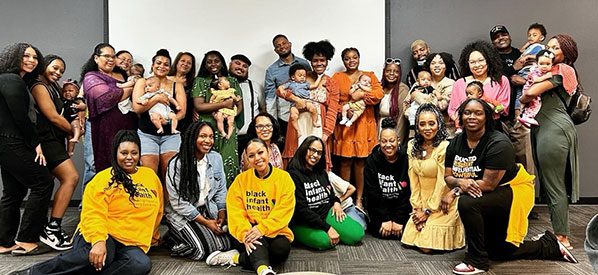
Locally in San Bernardino County, a $2.72 million allocation for Black Infant Health and the Perinatal Equity Initiative includes funding for no-cost doulas, fatherhood programs and maternal mental health services, peer groups and data collection staff.
With funding from the county, the Sankofa Birthworkers Collective reports serving about 40 mothers annually, out of an estimated 1,800 to 2,000 Black births occurring each year, according to the County’s 2023-2025 Maternal Health Data Snapshot.
But the latest county indicators also show persistent racial gaps in early prenatal care access. From 2020 to 2023, 76.3% of Black mothers began care in the first trimester, compared with 86.6% of Asian mothers and 82.1% of Latinas.
The County Department of Public Health said Black Infant Health tracks progress through participant outcomes tied to stress reduction, prenatal care engagement and healthy behaviors, and said that reporting from newer contracts will follow once the data becomes available.
On the community outreach side, Karen Scott said their First 5 agency’s programs are intended to be accessible to all.
She said initiatives like the NAEBOR Clinic and the Maternal Health Network are primary examples of funded services, and their community engagement team is active at events such as the Fontana Black History Parade and the Martin Luther King Jr. Parade.
“In addition, F5SB’s graphic communications are designed to represent the diversity in our county across all demographics including Black-African American,” said Scott, Executive Director of First 5 San Bernardino, in an email.
Coming up mid-March the Healthy Start Enhanced – San Bernardino, HSE-SB Consortium meeting will host action planning workgroups, and Black maternal health advocates may also be looking for evidence of how millions in state and federal funding are reaching local moms.
Especially in the High Desert, the ‘perinatal desert,’ where checkups can run into hours of bus travel, the County’s 2026 goals include 10% telehealth expansion in Adelanto and Hesperia. The department said it is exploring mobile medical units to expand access to community-based perinatal services. They did not say when units would be available in the High Desert.
The Maternal Health Network of San Bernardino County says the sessions aim to expand early screenings for high-risk pregnancies and gather better data to show how effectively the $2.72 million in BIH and PEI funding is being used.
The good news is that visiting doulas are now on call.
Late last year, the California Black Birth Equity Summit in Sacramento commended the Freedom to Birth Act, AB 55. Effective January 1, the barriers that limited Medi-Cal reimbursement for doula services are removed, making access to quality care protected under state law.
Every little bit helps when it comes to survival.
As of 2024 CDC estimates tracks a broader category called Severe Maternal Morbidity (SMM), which are unexpected, life-threatening complications affecting over 50,000 U.S. women annually with Black women over twice as likely to experience near misses.
In just two of many cases, Kira Dixon Johnson, a Black marathon runner and pilot, died after a routine C-section. Her husband begged staff to help for ten hours because blood was in her catheter. Tennis champion Serena Williams almost died because of a blood clot in the lungs, and had to scream for help after her medical staff did not listen to her.
When it comes to equity, education also doesn’t seem to matter much.
A 2025 KFF U.S. data analysis found a Black woman with a PhD is more likely to die in childbirth than a white high school dropout; the CDC notes the rate for college-educated Black women is five times higher than white peers.
For Riverside County, a $2.5 million PEI/BIH allocation has stepped up with different kinds of intervention.
Danielle Huntsman, Deputy Director of Riverside University Health System – Public Health, said the county’s Black Infant Health and Perinatal Equity Initiative rely on their longstanding foundation of faith-based and Greek-letter partnerships.
“We have partnered with Living Way Community Church where our BIH Group sessions have been held for more than 10 years,” Huntsman said, adding that they are excited for their other organizations include Mount Rubidoux SDA Church and sororities Delta Sigma Theta and Zeta Phi Beta, that provide direct support through community events and baby showers.
Best of all, she said Riverside has already implemented a hybrid model to address its own geographic barriers.
For their April 1 Community Advisory Board meeting, Huntsman said their agenda goes beyond outreach strategies to report on the actual number of clients enrolled and the tangible impact on families.
“At each quarterly CAB meeting, the BIH and PEI programs review their progress by reporting on the number of clients enrolled and the impact of the program on the mothers, fathers and infants served,” Huntsman said.
In Riverside also receives Perinatal Equity Initiative (PEI) funding. Recent board actions show allocations such as $480,000 specifically for Community Doula Services, partnering with the California Black Women’s Health Project and Sankofa Birthworkers Collective, to address these births.
She said their virtual participants get the same access to education, resources and services provided to all enrolled moms.
“The BIH program is designed to be an in-person group experience,” she said,” however we accommodate our enrolled moms by offering virtual participation. This includes our moms who live in the desert region of Riverside County, as well as those who cannot attend in-person group sessions.”
Looking at 2016–2017 death certificates, researchers Eunice Kennedy Shriver National Institute of Child Health and Human Development 2023 analysis shows racial disparities in maternal health are persistent, and growing.
They found that Black, non-Hispanic mothers now face a maternal mortality rate 3.5 times higher than White, non-Hispanic mothers, up from 2.5 times in earlier studies.
The California Black Health Network points to implicit bias in birthing, and how some medical trainees still believe false myths, like that Black people feel less pain or have thicker skin.
Their report, Perspectives Report on the state of Black Maternal Health in California, shows how the gaps show up in prenatal and postpartum care, from counseling access to mental health support, and are shaped by both system failures and real-world barriers like transportation, childcare, and stigma.
“A 2018 survey, Listening to Black Mothers in California, revealed that our healthcare system disregards many concerns of mothers of all races and ethnicities, and Black mothers are among the least listened to among patients,” the report said.
For more information, see:
San Bernardino Black Infant Health, see
Riverside RU Health, Black Infant Health, see
https://www.ruhealth.org/public-health/black-infant-health
CA DPH, Perinatal Equity Initiative
https://www.cdph.ca.gov/Programs/CFH/DMCAH/PEI/Pages/default.aspx
To read the report, see CBHN report:
https://yourcbhn.org/wp-content/uploads/2021/11/CBHN-Perspectives-November-19-Update.pdf
To see Charles Johnson’s advocacy for Black moms, https://4kira4moms.com.
