
Robin Thorne: Opportunities in Construction and Demolition
By Dianne Anderson
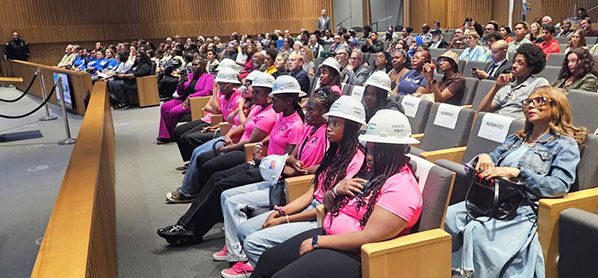
Pink shirts and white hard hats still stand for hard work, something Robin Thorne knows firsthand in the demolition field, where she has also noticed something else over the years.
Along the way, the higher up she goes, the more the challenges expand, the more focused she gets.
Now in her sixth year, Thorne is keeping her intention, expanding her firm, opening doors for young women and men in infrastructure and public works.
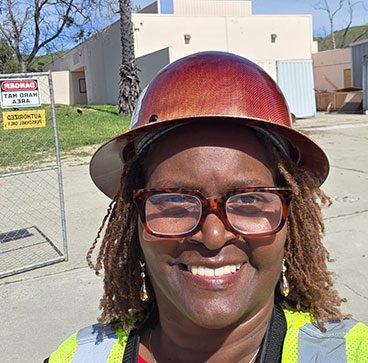
“I don’t want to be limited because there’s so much of a need out there. As for my experience in what I’ve been able to touch, I don’t want to limit it,” said Robin Thorne, Chief Executive Officer of CTI Environmental, Inc.
Thorne, also founder of DemoChicks, a nonprofit organization, runs her environmental compliance and demolition firm handling hazardous material testing, demolition and remediation, safety compliance and workforce training.
To date, some of her major projects include involvement with the $1.3 billion I-405 widening project, which added lanes in both directions. As part of the program management team, Thorne’s contract was worth more than $3.5 million and included underground utility coordination, scheduling, administrative support, and document control.
At the Long Beach Airport, her firm is also part of the cargo modernization project, where they perform lead and asbestos testing as well as soil testing. She highlighted her infrastructure work tied to Los Angeles County Metropolitan Transportation Authority projects in partnership with Arcadis, including bus depot facilities such as Division 8 and Division 15.
But, she doesn’t shy away from smaller tasks, always looking to bigger goals down the line.
Short term, she wants to deliver smaller scopes of work as they are called out. Long term, she looks to increase their role and contract value.
“I want to show that we’re part of these major projects,” she said. “We want to increase our dollar amount, but it still means the fact that they’re reaching out to us to participate on these high profile projects makes a statement.”
She also wants her team to look at the big picture, and understand that operating inside major, high-profile infrastructure projects is also about creating trust and opportunities to grow.
Robin Thorne
Under political pressure, big businesses now don’t have to be inclusive or have scaled back DEI nationwide. At first, she also wondered about losing her woman-owned government contract, but she hasn’t felt an impact, thanks to clients who appreciate diverse small businesses (SBEs) despite roadblocks for Disadvantaged Business Enterprises (DBEs).
“Now, if somebody was looking for an out, They got it,” she said. “But having good relationships with companies where that’s their culture, to support small business, we’ve been very fortunate or blessed that it hasn’t had an impact on us.”
The field is still wide open for women in nontraditional roles, those that can stack certificates, skilled general labor on certain public works or specialized demolition and environmental jobs pay high hourly rates. A college degree is not required, but certifications, experience and job classification matters.
One of her pink hats on the team is still actively taking classes, including the 40-hour HAZWOPER Hazardous Waste Operations and Emergency Response, safety certification, and other Army Corps-related safety training and additional related industry courses.
In 2019, she was paying someone $42 an hour for general labor, and certifications also help get someone in the door.
“It depends because some people don’t want to wait. They want to get to work right away. They can go through an apprentice program while they’re getting paid and while they’re training,” she said, adding that they refer out to WINTER, Women In Non-Traditional Employment Roles, pre-apprenticeship program.
Thorne, a member of the LBCC Foundation Board of Governors, also provides scholarships for safety equipment to ensure young women can move safely and smoothly into the field.
“I want my contribution to go towards safety equipment for a young lady who’s enrolled in one of those programs because they have automotive, electric and architecture, technology,” she said. “They call it CTE, career technical education programs.”
So far, DemoChicks has served over 700 students and awarded over $30,000 in scholarships to women entering architecture, construction, and engineering fields. Thorne hosts an eight-month program for 12 middle and high school girls to experience architecture, manufacturing, and fabrication sites, including an active Long Beach Unified construction site, where project managers explained the pricing and development process.
“They took them out in a field to see different projects,” she said. “The Mayor actually invited us to city council and he presented us with a certificate and all the girls were there with their pink hard hat.”
Earlier this month, she was invited to speak at CSULB to women in engineering. At first, she wondered what to talk about, and the answer was clearly environmental engineering and impact. She was amazed at the knowledge base of the women, as they lined up to learn more of her program.
“I work on [it] every day. So why create something else? Let me talk about what I do. Another lady talked about PFAS, and I was like, they’re so nerdy, right? It was pretty cool because I had a line,” she said.
Not long ago, she was invited to Maryland to engage Black high school students on infrastructure, and she stressed the importance of sparking curiosity early on.
“A good thing is in a Black community that we’re introducing our youth to careers and infrastructure, like how the bridges get built, building, and all the things you really don’t think about,” she said.
Besides marketing and expanding visibility for the firm, her focus is getting young women of color into demolition and construction roles, field engineers, safety tech, and construction management. Right now, her team has three full time pink hats, one in demolition space, and two as construction managers. They also have a field engineer, and a safety tech.
Last month, Thorne was named the 2026 Woman of the Year for California’s 33rd Senate District by Senator Lena Gonzalez, honored during the official ceremony at the State Capitol in Sacramento.
Recently, she was just as thrilled when one of her infrastructure clients asked if they could partner to bring on DemoChick interns. She feels there is plenty of room for her firm to handle major projects, while training and developing new workers.
They can operate in both spaces.
“I’m always told, Robin, you have the workforce development piece and you have the projects. But I think there needs to be more development,” she said, adding, “I know how to get projects, I know how to execute the work, and I know how to train the girls.”
For more information, see https://www.ctienviro.com/
