
Felicia Jones: the Power of Black-Led Philanthropy
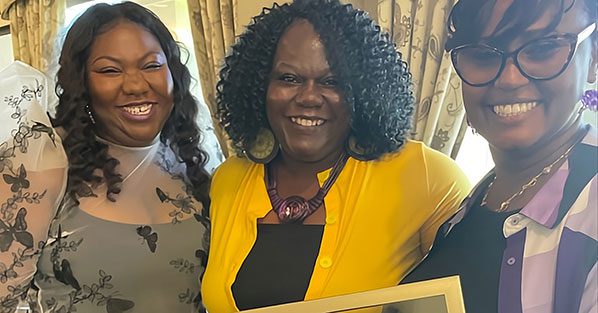
by Dianne Anderson
Felicia Jones makes blazing the trail look effortless, behind the scenes and as the public voice, but it wasn’t always so.
Her young teens were caught up in heartache where she was born and raised in South L.A., and she saw a lot of wreckage along the way.
Growing up under the crack cocaine epidemic that took down many families, including her own, she also saw how the church stepped up, giving her family hope in the worst of times.
“When we had those moments of instability. I knew the power of the congregation also in being a safety net for our communities.”
It was there that she got a firsthand view of dignified community organizing, and the power of Black nonprofits that came to the rescue of many, including her dad, who was addicted to cocaine.
“We ended up moving from our home. It does inform a lot of orientation,” she said.
That pivot point became her calling, sparking a lifelong commitment to do real work in troubled times.
Standing in the gap, her single mom pursued a nursing education to pull them out of poverty, but like most kids in 7th grade, she started hanging with the wrong crowd until her mother got her bused to the Valley. It was a different world and culture shock.
“I understood the academic deficits I came to the school with, but generally I loved school. I got access to programs and support that helped me to navigate,” she said.
Despite being a good student, her high school counselor in that overwhelmingly white school district tried to redirect her from going after a university education. Her mom intervened, and Jones applied and was accepted to a college, where she didn’t quite appreciate all those late-night study hours.
“I partied way too much, didn’t take studying very seriously, struggled academically for my own lack of discipline, I fell out of school,” she said, adding eventually she came back around, graduating from a small private university, to become the education advocate that she is today.
Being hyper-aware of community work, she organized in her church where she first saw how Black people were standing up for justice.
“I was like how can I be part of this?” she said.
Once graduated, Jones also worked for a college in Orange County, but felt it wasn’t her hitting her purpose, so she walked away, still buried in student loans, to take a small part-time job and organize for the community.
She kept the faith.
“I had a constant reminder that God was always with me, guiding and catching me when I fell,” she said. “But God was so faithful to me to open doors.”
Focused on the housing issues when she moved to the Inland Empire from L.A. in the early 2000s, she connected with Congregations Organized for Prophetic Engagement (COPE), where she continues as advisor and emeritus executive leader and staff member.
She said it was a turning point.
“That’s how I got into this work, watching the pain of how my family was destabilized because of the cocaine epidemic and what we lost. I wanted to do something about it,” she said.
Those early 18-year-old memories included powerful women in her life, a white Jewish councilmember Ruth Galanter, who hired her as an assistant, where she took calls and heard community concerns, along with a Black Field Deputy Valerie Shaw. Both of her first bosses in life exposed her to what was important about the inner workings of public life.
These days, among her many hats as she sits at many tables, she said her work is made powerful with like-minded colleagues, mostly Black, who understand the power of community grant making and trust-based philanthropy. Her inner circle of long-time friends Kaci Patterson and Dina Walker, which she said are a few of too many to name, inspired and shaped her community outreach.
Across several roles, Jones helps coordinate strategy and resources to advance equity, including work as Managing Director of Programs and Operations for the Black Equity Collective, and her role with Social Good Solutions where she advances equity through consulting, strategy, and program development.
But she said it is important that the decisions are left to the community to design how resources go back into their community.
After the murder of George Floyd, money poured down with philanthropists making multi-million dollar commitments for Black-specific work. A lot of it has dried up and some of those commitments fell short.
“Yet, we still continue to pursue the work,” she said. “We’re reaching organizations who would not have probably ever showed up on the radar of traditional philanthropy.”
Through the Inland Empire Community Foundation (IECF) and the M.E.C.C.A. IE Fund, formerly the Black Equity Fund, she serves as Fund Manager for the IEGives Partnership, guiding organizations with a coalition and support, helping programs that might not have shown up on the radar of traditional philanthropy.
It’s also a way to unify and strengthen advocacy in housing to maternal health, education, workforce issues, and criminal justice reform.
Over 25 years working for the heart of the community has led up to the success of the past six years of the Black Equity Fund in getting critical dollars where needed.
Slow but sure, she said they are seeing progress.
“I think there’s a lot of work still to be done,” she said, adding, “While there is great progress on one end, we know that there are still gaps on the other end.”
As a mentor, she calls it a privilege to commend Rev. Samuel Casey, a friend and partner in this work who has opened up the opportunity for her in the IE.
And out of that came a movement.
“I certainly want to help women formally and informally where I can,” she said. “I do work at a firm that is predominantly ran by Black women and I get the privileged role, elder, the majority of women are younger. It’s beautiful to pour into them their leadership.”
For more information:
M.E.C.C.A. IE Fund (formerly Black Equity Fund), see https://www.iegives.org/funds/meccaiefund/
Inland Empire Community Foundation (IEGives), see https://www.iegives.org/
Black Equity Collective, see https://www.blackequitycollective.org/
COPE (Congregations Organized for Prophetic Engagement): https://copesite.org/
