
MOLAA Afro-Latinx Beats of Resistance, Free Festival

By Dianne Anderson
Afro-Latinx beats, dancers and food to match the community’s most distinguishing culinary taste buds sounds like a great block party, but then again, it vibes like an open air gallery of cultural fusion with cerebral meanderings.
This year’s free Afro-Latinx Festival at MOLAA is breaking out the rhythm of resistance with a layered lineup of the diaspora from arts to scholars to rumba and hip hop with DJ iLLMeca, Puentes de Poder, Plenazo Tribe, and Kati Hernandez y Kimbambula.
On Sunday, February 22, the community is invited to come out, re-energize, celebrate the best of all worlds from across the African diaspora in Latin America and the Caribbean. The event, to be held at The Museum of Latin American Art (MOLAA), runs from 11:00 a.m. until 5:00 p.m. at 628 Alamitos Avenue.
Solimar Salas said their team has worked tirelessly to deliver not just topical knowledge of the cultures, but a community wide experience that is focused on the depth of Afro-Latino Heritage and Cultural Diversity.
She emphasized that the program goes beyond entertainment value, and instead creates a space where history, identity, and celebration intersect.
“The festival highlights the richness and diversity of Afro-Latino identities across Latin America and the Caribbean through live performances and artistic engagement,” said Salas, Vice President of Museum Content and Programming at MOLAA.
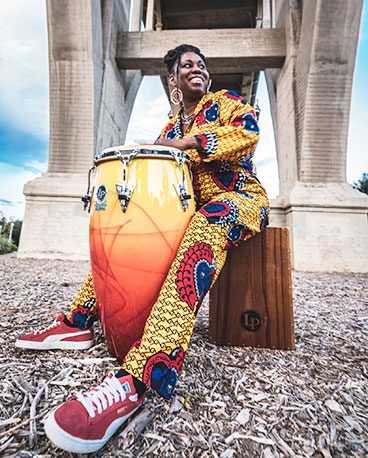
Puentes de Poder
On stage, DJ iLLMeca will spin hip-hop, salsa, and soul while Puentes de Poder and Plenazo Tribe will push the beats of Afro-Indigenous and Afro-Puerto Rican culture. Kati Hernandez y Kimbambula rolls into rumba and traditions in Afro-Cuban jazz.
Offstage, the visual storytelling continues with Afro-Chicano muralist Josiah O’Balles leading hands-on workshops on BIPOC narratives and working-class histories. Lowrider pioneer Tina Blankenship-Early, widely known as the first lady of the lowrider community, presents her iconic 1966 Chevrolet Caprice “Game Killa,” with its chrome and custom detailing reflecting decades of community pride.
Beyond the performances, Salas said the festival is also designed to deepen the connections with the Black communities, and reinforce ties among Afro-Latino, Black, Latino, and African American partners.
“We’re providing that forum for other organizations that are doing really important and strong work, in this case the African American community, to have a voice and speak as they’ve been doing it,” she said. “We want to make sure that we’re partners in this case to amplify the reach of the voices of our community partners.”
As MOLAA steps up advocacy and cross-cultural dialogue, collaborations with groups like the Black Alliance for Just Immigration (BAJI), the African American Cultural Center of Long Beach, the Garifuna Museum of Los Angeles, and Puentes Latino also reflect many shared social justice concerns affecting Black and Brown communities.
For MOLAA, she said the mission has been to capture the real legacy and to make sure the celebration continues to tell the community’s story on a multi-perspective level. The emphasis is on layered histories, ancestral traditions, and making room for the voices that are shaping culture today.
“It’s not just what MOLAA wants to say, how we collaborate with California museums, how we collaborate with the African American Cultural Center of Long Beach, so we make sure there is accuracy in how we’re presenting the performers and storylines,” she said.
Students from the LBUSD Pathways program, including Jazylin Dizon and Andre Grady, have taken part in their role behind the scenes, gaining hands-on experience in festival production, and classroom concepts into the real world.
Each year, she said the festival spotlights different traditions within the diaspora. Previous events looked at Afro-Peruvian dance, Chicano-Jarocho music, and Afro-Brazilian drumming. This year’s program highlights Afro-Cuban performance, Oricha cultural traditions, Puerto Rican Plena, and Afro-Panamanian talent with a lineup to showcase the depth of Black and Afro-Latinx cultures.
For those looking to participate, vendor applications are open. MOLAA’s Education team, alongside prominent Black and Afro-Latinx community leaders, are calling on merchants, artists, and performers through social media, newsletters, and community networks. Applications are available on the museum’s website.
When Latinx and Afro-Latinx artists are placed front and center, Salas said it creates space and helps communities talk to one another and to better understand each other in solidarity.
“At MOLAA we are eager to create bridges and conversations between our complex and multi-cultural communities,” she said. “Together, we can amplify and celebrate Afro-Latinx culture, art, and innovation along with the support of our advocates and allies.”
For more information on this and other MOLAA events, visit molaa.org/events.
