
CASA: Foster System Impact on Black children
By Dianne Anderson
In her four years working with foster youth, CASA volunteer Julie Spacht reflects on one of the main things for people to know about the foster system is that the kids usually are in the system for a reason – and that reason is traumatic.
In the best of circumstances, she said the parent has died and the child realizes that it wasn’t their fault, but in the worst of circumstances, the parent comes and goes and comes and goes.
“They see it as their fault and that the parent doesn’t love them, or if there was abuse, or the child doesn’t fully understand why they’re left standing and wondering what did I do wrong?” she said.
As part of her role as a Court Appointed Special Advocate, she handles more of the logistical and administrative side, such as advocating for various needs, education and mental health services.
For all children in the foster system, she said getting extra accommodations is always a hard fight.
“The process of getting IEPs [ Individualized Education Program] is so onerous I found that awful a lot of children are in the cracks of needing an IEP, just plain needing stability enough in one area to keep going at a good rate,” she said.
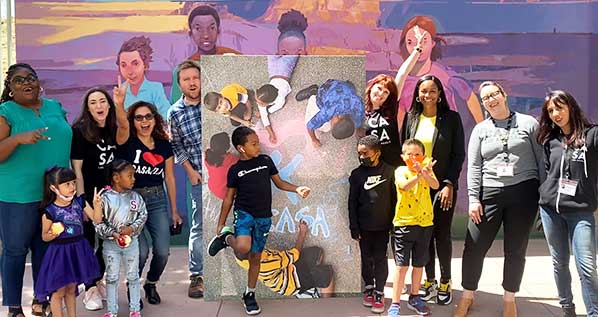
CASA needs more advocates and volunteers, particularly for Black men, of which they have very few. She said that several white women are volunteers, and they even have attracted a large group of youth volunteers.
Spacht, who is white, said the good news is that placing a Black child in a Black foster home has not been difficult, and it is important because the home is where the day-to-day cultural contact happens.
On the whole, foster kids are frequently shuffled in and out of homes, switching up schools and teachers, and trying to cope with trauma in different ways.
“The foster family, for whatever purposes, can say in seven days I want this child moved. And that may happen three or four times, but that happens. They just need stability,” she said.
One child that she has volunteered with had built up an emotional wall as a way of self-protection. Another wanted to fight, but in the process ended up learning how to become her own self-advocate. The foster youth, who is African American and is now 20, is thriving and has become certificated in the medical field.
“She got in a little trouble from time to time, but she has become very successful, somewhere along the line she learned that advocating for herself has been the single most [element] to her success,” she said.

Among all of the problems facing foster kids, Black kids seem to be taking the brunt of the process.
But one way to alleviate the stress of the overpopulated foster system is by creating a watchdog for biased referrals that disproportionately push more Black kids into the system than white kids. From there, they are pipelined to prison.
In one 2019 study using data from Cornell University, researchers show the pipeline to prison starts early because Blacks and that Black parents are targeted, and twice as likely to be reported to child services than white parents. Black children were more likely to be removed from the home.
“The likelihood of interacting with child welfare systems is dramatically higher for children of color. About half of all African American children will experience a child welfare investigation before their eighteenth birthday,” the study said.
Similarly, about 30 percent of all Americans – but 49 percent of young Black men will experience an arrest by age twenty-three.
Overpolicing and heightened surveillance in Black communities follow the perception that Black parents are bad, the report adds, “Tight symbolic and legal associations among race, gender, ethnicity, criminality, and parental fitness inform both cognitive and institutional classification routines that lead officers, caseworkers, and agencies to view poor women of color as unfit parents who may pose a danger to their children.”
The U.S. Department of Health and Human Services Children’s Bureau also notes in their publication this year, “Child Welfare Practice to Address Racial Disproportionality and Disparity,” that Black children spend more time in foster care, and are less likely to reunify with their families. Compared with white children, the researchers show they are less likely to receive services. In addition, African-American and American Indian or Alaska Native children are more likely than other children to be removed from their homes and to experience a termination of parental rights.
April Parker, a Long Beach community-based nonprofit leader, and a long time foster parent, isn’t surprised. She finds problems, such as access to foster services within the community exist on several levels.
Parker has never used CASA services, but she believes that part of the disconnect why CASA has had so few Black volunteers is because of the lack of targeted recruitment.
She said that CASA outreach and programming hasn’t been readily visible or available to the African American community.
“How do they recruit volunteers? It’s like they’re hidden away in the courthouse, but nobody really knows they’re there until the court says there’s not an adult to support this child,” she said. “However, it’s needed because the more people you have to serve the children, the better.”
To see the study on Family Surveillance: Police and the Reporting of Child Abuse and Neglect, https://www.rsfjournal.org/content/5/1/50#sec-1
For more information or to volunteer, see CASA Long Beach Office at
https://casala.org/locations/130/colonial-life-office/

Leave a reply
You must be logged in to post a comment.