
Resource Fair Gets Ahead of the Next Overdose
By Dianne Anderson
Conversations around fentanyl overdose usually start after the crisis, or after death, when there’s nothing left to prevent.
In 2024 alone, nearly 48,000 people died nationwide in overdoses involving synthetic opioids such as fentanyl.
This weekend, Long Beach is trying to get ahead of the next one, starting with things that could keep somebody alive. The new approach is bringing tools to prevent overdoses, recovery support and connections to local services in one place, and those who show up will leave with more than a tote bag.
They may have what they need to save a life.
On Saturday, August 29, The City of Long Beach will host Turning the Tide: Navigating Local Programs & Services, a free community resource fair recognizing International Overdose Awareness Day, at MacArthur Park, 1321 E. Anaheim St.
Ismael Salamanca, a spokesperson for the city Health Department’s Harm Reduction Program, said the fair is designed to help residents find and navigate local services year round.
“All of the programs and services are local to Long Beach and will continue to operate with a variety of schedules. This year’s resource fair was created to bring attention to the many organizations, partnerships and services available in Long Beach and to help residents learn how to best navigate them,” said Salamanca, with the city Health Department’s Harm Reduction Program.
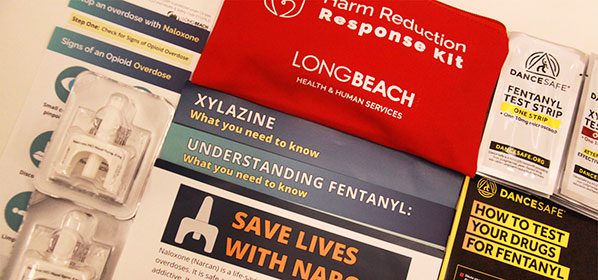
Residents can get HIV and STI testing through Bienestar Human Services, CalFresh and Medi-Cal enrollment assistance through the Los Angeles County Department of Public Social Services, and naloxone and fentanyl/xylazine test strips, Salamanca said.
Also featured, the fair includes demonstrations for naloxone administration and rescue breathing.
Partners will offer mental-health referrals, along with grief and support groups, medications for addiction treatment, substance-use treatment and rehabilitation programs, and outpatient drug and alcohol services. Long Beach Homeless Services will help participants find resources and connect to care.
He said the fair brings together the City’s Homeless Services, PrEP and Harm Reduction programs with 11 local and regional providers, including its lead sponsor L.A. CADA, Bienestar Human Services, the Los Angeles County departments of Mental Health and Public Social Services. Also partnering, NAMI Long Beach; Roots Through Recovery, Tarzana Treatment Centers, AADAP, American Indian Changing Spirits, Urban Social Services & Advocacy, and Safer Refuge.
“Because there are frequent changes among community-based organizations, we always encourage residents to call ahead to confirm hours and available services, including any eligibility requirements or costs. While most programs offer free or low-cost services, some may require sliding-scale fees or insurance,” Salamanca said.
Locally, the overdose crisis has also surged. Yearly opioid-related deaths among city residents jumped 326%, from 23 to 98 between 2018 and 2022, according to the Long Beach Department of Health and Human Services’ Opioid Overdose Report.
Fentanyl was a main reason for increase with fentanyl-related deaths surging 1,640% from 2018 to 2022 and involved in 263 of the 332 opioid-related deaths recorded among Long Beach residents during that period.
At the county level, the numbers are getting better. In 2024, Los Angeles County recorded 22% fewer drug-related overdose deaths than the year before, from 3,137 to 2,438. Fentanyl-related deaths also fell, down 37% from 2,001 to 1,263.
But that progress is not across the board.
Black residents continue to die from overdoses at disproportionately high rates, showing the need for targeted outreach and resources in impacted communities at a critical level.
As of the City’s most recent data, Long Beach had 4,038 residents living with diagnosed HIV, a rate of 865.5 per 100,000 people. Countywide, Black residents accounted for 22% of new HIV diagnoses in 2023 and had a diagnosis rate more than three times that of White residents, while Latinx residents accounted for 47% of new diagnoses, according to Los Angeles County’s 2024 HIV Surveillance Report.
For residents who cannot attend the fair or need help after it ends, L.A. CADA’s Long Beach Outpatient and Community Services Center offers a place to get substance-use and behavioral-health care without a lot of hurdles.
“Most importantly, our staff can provide a brief, no-pressure needs screening to help connect someone with the care and support that best fit their needs,” said Nolan Ross Samé-Weil, L.A. CADA’s director of development. “Meeting people where they are is at the heart of our approach.”
Services include outpatient treatment, counseling, case management, syringe services, contingency management and medications for addiction treatment, offered in person or by telehealth. The organization also offers Enhanced Care Management for eligible Medi-Cal members.
There, staff can answer questions about medications for addiction treatment, including FDA-approved medications for opioid, alcohol and tobacco use disorders, as well as off-label options for stimulant-use disorder. Same-day medication access is available.
Samé-Weil said L.A. CADA accepts most major insurance plans, including Medi-Cal, and serves people regardless of insurance status, immigration status or ability to pay. The Long Beach center is at 5861 Cherry Ave. and is open Monday through Saturday.
“Someone can begin wherever they are, from an initial conversation to comprehensive outpatient treatment or coordinated care through Enhanced Care Management,” he said. “Residential care is not a prerequisite for receiving support.”
HIV prevention is another big focus for the fair.
Christian Perez, Bienestar Human Services’ supervisor for Harm Reduction Services, said the organization will offer HIV and STI screening, naloxone, fentanyl test strips, syringe services, and referrals for medical, mental-health and substance-use treatment.
Perez said Bienestar’s Pacific office is currently closed as the organization works to secure a new lease. For now, Bienestar operates a mobile site at MacArthur Park, 1321 E. Anaheim St., on Wednesdays from 10:00 a.m. to noon.
For naloxone, fentanyl test strips, safer-use supplies and syringe services, Perez said, people can contact or visit Bienestar’s Harm Reduction Center.
“These materials are available to clients who walk in through our doors, and our staff can also provide education and assistance as needed,” Perez said. “For HIV/STI testing, treatment, mental health referrals, or other healthcare needs, individuals may contact our main office so that we can connect them with the appropriate services.”
For more information, see:
Harm Reduction Program, contact the Health Department front desk at (562) 570-4000, visit longbeach.gov/ioad.
To learn what’s available and where to start, visit https://longbeach.gov/health/diseases-and-condition/information-on/hivstd/hiv-syndemic-policy-program/community-resources/
L.A. CADA, contact nsameweil@lacada.com.
https://longbeach.gov/health/diseases-and-condition/information-on/hivstd/hiv-syndemic-policy-program/community-resources/
For the latest LACounty HIV Surveillance Report, seehttp://www.publichealth.lacounty.gov/dhsp/Reports/HIV/2024AnnualHIVSurveillanceReport.pdf
