
John Hoover Coleman, The Man Behind the Camera

By Dianne Anderson
Across the Inland Empire, John Hoover Coleman could be found almost any day of the week, and at most important events, with his camera in hand documenting the faces and places of civic action, celebrations and the people who shaped local Black history.
Coleman, known as the “People’s Photographer,” died earlier this month. He was 96.
Beverly Jones Wright said that he was her first mentor, and came to her rescue after she was accepted as a San Diego State freshman. Wright said a registration mix-up with a junior transfer who had the same name would have delayed her enrollment by a year.
“I’m not sure how he made that happen, but he told me, ‘you’re going to school and you’re going to get your suitcase and go right back up there.’ I did. But after that, he guided me in all of my different health activities,” she said.
Later, Coleman also encouraged Wright to join the ACS board, where he was already serving and volunteering. She said that he made a huge contribution, both to the organization, and more so to the community.
“The whole reason he encouraged me was because of the lack of diversity on that board and the whole cancer promotion in the African-American community, for sure,” she said.
At a Westside Action Group tribute late last year, Wright said their organizers planned to send an Uber to pick up Coleman for the event, but before they could, he had already driven himself there, and perfectly parked.
“If I had to parallel park, I couldn’t even try to begin to get in that spot. But he got out of the car and, [said] okay, here I am,” she laughed.
For Coleman, life both before and after retirement was all about community service, donating time and talent, providing prints to the Black press for publication.
Donated to Cal State San Bernardino in 2021, his materials fill 22 linear feet and include prints, albums and digital photographs documenting inland empire events from about 1990 to 2020.
At the tribute, WAG recognized “John Coleman Day” for his decades of commitment to capturing the moment and every opportunity to show the Black community in a positive light.
Alton Garrett, WAG president, said they celebrated his legacy, but he emphasized that all the accolades and all the adjectives in all the world is not enough to describe his longtime friend’s dedication.
He is glad that WAG gave him flowers “while he could still smell them because he was a one-of-a-kind person,” and supported so many important efforts and organizations around the IE.
Garrett said he was always overjoyed at documenting the history of the community.
“John was always the person out there taking pictures, regardless of the event, not how big it was, or how small it was,” he said. “He marched to the beat of his own drum, not to what everybody else may be doing. In my opinion, he loved the community that he lived in.”
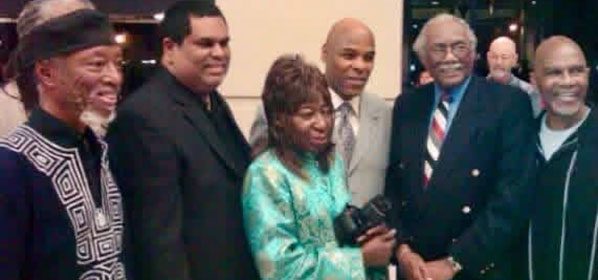
John Coleman (far left) recognized with other Black photographers for their contributions to the community at an event held at the County Government Center in San Bernardino (circa 2010). Photos: Tillman
Born in Boston in 1930, Coleman served in the Korean War, earned a master’s degree in social work and moved to California in 1958, where he worked at Patton State Hospital before joining UC Riverside a decade later. There, he served as the university’s inaugural ombudsman from 1968 to 1969.
Retired from UCR in 1992, he poured his passion into photography spanning all facets of Black life, who was being honored, who was leading the community forward, and organizing for the betterment of the people.
He was always snapping away, not leaving anything to chance or memory. His civic work included chairing Redlands’ Human Relations Council, along with photojournalism around desegregation, housing, health care and community relations.
During the pandemic, he felt an urgency to pull all his photographs together to preserve the names, dates and stories, to ensure they weren’t lost to future generations. He was also watching the higher death rates from COVID in the Black community.
Growing up, he also witnessed the impact of healthcare access and disparities. He said hospitals today are concentrated in downtown Riverside and San Bernardino, and also are leaving people in outlying communities stranded.
“There was a real issue in terms of the human needs around issues of health, diabetes, being a real concern to so many of us,” he said, adding, “Right from the time I was a little kid, I’ve seen lots of Black folks who had amputations.”
David Veneziano, formerly executive vice president ACS, retired about five years ago from the California division, spanning about 30 years with the organization. During the last 15 years, he worked with Coleman, who was on the board of directors.
ACS could always count on him being a strong advocate at the local and state level, with a heart for everyone. But, he said that Coleman was acutely aware that the Black community was very heavily impacted with prostate and late-stage diagnosis breast cancer.
“He always spoke so eloquently on the needs of patients and things that we probably should be doing better,” Veneziano said. “We always took his input because he knew what he was talking about being a practitioner in his career.”
He described Coleman as one of the most quintessential volunteers he’s known with ACS, always committed. Because of his background being in social work, he had a strong sensitivity to cancer patients.
In his decades, Coleman kept the community in sharp focus, making sure the people were presented in the right light at the right time, to be seen and never forgotten.
Wherever he was needed, from the desert to Los Angeles, Veneziano said Coleman would travel, and he was very active in tobacco-control advocacy.
“If you called him, he wouldn’t say, I’ve got this. He would say, what would you like me to do? And he did it with a smile on his face,” he said. “You can’t help but really show such a love for a spirit like that.”
To see the interview of John Coleman (March 25, 2021) by Wilmer Amina Carter Foundation Bridges Project:
