
Rev. Dr. Raymond W. Turner: Legacy of Faith and Action
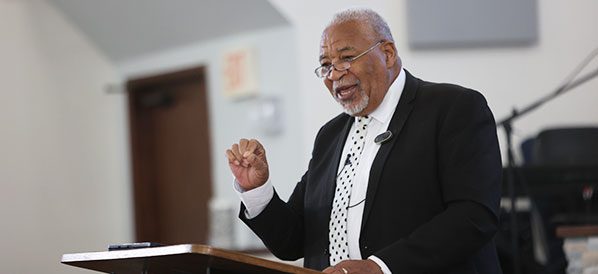
By Dianne Anderson
For decades, the pulpit was only the beginning for Pastor Ray Turner, stretching from all corners of community outreach, from the altar to the ballot box, to Black-led civic organizing, and education, turning faith into action.
Ask what shaped that leadership style, and, at least for starters, he credits the Air Force.
Growing up as the 11th of 15 children in Virginia meant limited opportunities. Like so many young Black men, options were slim or none and the military offered a GI Bill and a career move.
It also gave him a different perspective.
“Imagine growing up on the West Side and never leaving the West Side. There’s a whole world out there,” said Rev. Turner, who served over eight years of active duty and four in the reserves. “That was one of the best things that happened because it took me out of that environment.”
He refused to let poverty define him. Today, that early philosophy fuels his work, guiding people out of generational poverty and stagnation. He said that growing up in a large, poor family in the South often meant the best-case scenario was getting a job.
Military service gave him a job, exposed him to the world beyond his neighborhood and inspired him to help others move past that state of mind. He often reflects on Dick Gregory’s famous distinction between being poor and being broke.
Having served around the globe, that mandate was urgent with his mission into the ministry.
“Not only did it give me a desire to tell people about Jesus, but also to help them move from their present situation to a better situation,” he said. “Knowing the power of God is that determination that people can move past a life of mediocrity.”
With a background in higher education administration, he served as director of Veterans Affairs in Marin County before taking a similar position at Chaffey College in 1978. After moving to Rialto, he learned another local lesson of where it was, and was not, safe to be Black. He said people warned him to steer clear of well-known Klan territory in Fontana.
He steered clear, but one day in passing a new construction site on the way to work, he saw a building named Loveland. He thought it was a bank or a nightclub.
“I had no intention of stepping inside,” he laughed. “It was funny, when I saw a sign that said Pastor Chuck Singleton, I thought, okay.”
His then four year old had recently asked why they weren’t attending church.
“I said well, I guess it’s just time to get these kids in church. Maybe I’ll try to go visit that place, Loveland,” he said.
That trek back to the pews led to his ordination under Pastor Chuck Singleton, whom he said was the first time he really heard preaching straight from the Bible. By early 1991, Turner took the pulpit at Temple Missionary Baptist Church.
But he had real concerns coming out of a Southern tradition where Black churches functioned mostly as emotional relief from Jim Crow violence and oppression. He felt called to shift toward a more practical approach, as well as spiritual growth.
By the early 2000s, Turner said Temple Missionary Baptist Church had purchased the 15,000-square-foot T. Hughes Building on Baseline as a hub for community outreach, women’s support services and neighborhood resources.
Even so, over time, government grants and welfare-to-work initiatives phased out. He downsized programs to the church’s main campus, focusing on the Westside’s academic neglect and expulsions that disproportionately affected Black children.
Safety and academics became priorities. Turner and the Inland Empire Concerned Clergy conducted campus walk-throughs to gauge local needs. He also founded Woodward Leadership Academy, a public charter school named after his late father-in-law, Capt. Ed Woodward, to give families another educational option and help students avoid gang threats and discrimination.

“Just that presence on the campus, I saw a difference,” he said. “Especially with Arroyo [Valley High School], we saw a decrease in expulsions and fights, disciplinary situations. And I just realized that it wasn’t so much the teachers or the curriculum.”
When the 1998 police killing of Tyisha Miller in Riverside sparked outrage, Turner and Rev. Joshua Beckley mobilized pastors, leading protests and launching the Inland Empire Concerned African American Churches (IECAAC). The anger intensified when the San Bernardino County Sheriff’s Department hired former Riverside officer Paul Bugar while he was under federal investigation for his role in the shooting.
“It felt like a slap in the face to San Bernardino’s Black community,” Turner said.
That hire empowered collective action. Working alongside partners like Congregations Organized for Prophetic Engagement (COPE), Turner helped bring churches together across denominations. As churches united, he insisted on leadership term limits so the community’s needs always came first.
“We want to make sure that we never allow the power to elevate our leaders to the point that we’re incumbent to them,” he said. “After many years of having pockets of influence, we were able to come together collectively as churches of different denominations and work together to try to effect change for the community.”
Beyond education and civil rights, Turner has focused on homelessness. He argues that faith-based organizations can often deliver services more effectively than bureaucratic programs because they give more, move differently and are guided by different motives.
For starters, he said current hotel voucher programs fail to address root causes.
“When they start passing out these vouchers for the hotels, they have $110 a night for a roach motel. How long can you do that? That’s not a homeless approach to homelessness,” he said.
Temporary shelter or leaving local vacant hotels as magnets for blight is wasteful spending. He believes those properties should be used as workforce-development hubs for unhoused residents.
“Right in that building, it could be a trade setup, where you could train people, and it would be self-sustaining,” he said.
After 35 years at Temple, he is preparing for the church’s next chapter as a new pastor steps in. He plans to write his book and hopes the congregation will honor what it has built so far, while making room for the next generation.
“It was more or less kind of going back to where God had brought us from Temple, encouraging the people not to quit. Encourage them to embrace the change that’s coming forward and embrace new leadership,” he said.
Rev. Dr. Joshua Beckley, senior pastor of Ecclesia Christian Fellowship, describes Turner as more than a friend, a ‘ride or die’ brother and longtime ministry partner. Their joint partnership provided the crucial sounding board for serving their churches and their community.
Both had arrived as relatively new pastors in San Bernardino around the same time, building what he called a “learning partnership.” They leaned in on each other to navigate the pulpit and civic advocacy.
“We had somewhat of an idea of what to do and not to do individually. But working together gave us each the sounding board we needed to make sure that our decisions and choices were genuinely from a heart of service to our churches and our community,” said Beckley.
From voter outreach with Measure C to policy work with COPE, he credits Turner’s leadership with shaping San Bernardino’s civic conscience and an approach that brought people and the community, especially the churches together in collaboration, unity, and genuine love and support for one another.
He feels that all can learn from Turner’s mentoring as he steps down, from his journey, from his successes as well as his failures, with the next generation.
Turner’s impact is evident in where Temple stands today and where it is prepared to go next, he said.
Alongside the IECAAC, which they built together, the church’s new leadership continues to reflect Turner’s heart for the community.
“Pastor Turner has a servant’s heart. It has never been about building a church as much as it has been about building people to reach their full potential in Christ. As such, collaboration was easy for him. It was always about what God wants me to be for you, and never about what you can do for me,” Pastor Beckley said.
