
Tenants Push Back, AG Lawsuit Spurs Action
by Dianne Anderson
On the heels of a recent lawsuit filed by California Attorney General Rob Bonta, residents in San Bernardino continue taking a stand against predatory property management companies accused of neglecting their homes and exploiting thousands of residents.
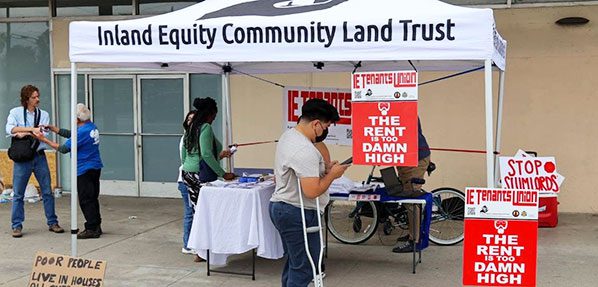
A recent rally drew dozens of local impacted residents calling for housing justice, among them Deborah Harmond, a San Bernardino renter.
Her involvement grew as people in her apartment building say they are dealing with uninhabitable units, including her own.
“We were abandoned by an owner, this real estate company took over and it took them two to three months knocking on doors and windows,” said Harmond, San Bernardino Tenants Union and vice president of the board of Inland Equity Community Land Trust (IECLT).
“We didn’t know who they were, they came in raising rent, but we had issues not met before these people took over which means these other people just did a quick sale and fled,” she said.
Her one-bedroom apartment was already uninhabitable, but the new owners increased rent and failed to address maintenance or habitability issues left over from the previous owners.
She had to go outside the region to seek legal help.
“There’s no attorneys in IE that will help the renters. We had to reach out to L.A., and Burbank. We were actually suing our building. By dealing with our issues, we created a tenant union through this,” she said.
Her rent had been $950, and raised to $1,075 before the old owners left, above the legal 10% cap on annual rent hikes. Under the Tenant Protection Act (AB 1482), rent increases are capped at 5% plus inflation or 10%, whichever is lower, over 12 months.
Lately as tenants move out, new renters bring in even more money in her building. She said they are paying $1,500 to $1,600 for a one-bedroom, often over 80% of their income for rent.
“It’s ridiculous,” she said. “We are helping people being unjustly evicted and being price gouged to where they can’t afford their rent, and then they’re being evicted.”
Although she is not a PAMA resident – the company targeted in the recent lawsuit by Attorney General Bonta – she emphasized the conditions that she and other tenants face are similar.
A recent complaint by AG Bonta exposes the Nijjar Companies as controlling over 22,000 rental units across California, mostly in low-income neighborhoods from Los Angeles to Sacramento. Their reach extends through Riverside, San Bernardino, Kern, and San Joaquin Counties, impacting thousands of vulnerable tenants.
Bonta states that Nijjar Companies aggressively expanded their portfolio during the post-COVID housing boom, acquiring over 900 units in 2020, 1,350 in 2021, and more than 600 in 2022, even as the companies accumulated thousands of habitability violations, including deplorable, unsafe building conditions.
But despite ongoing lawsuits and repeated code enforcement actions, Nijjar kept buying properties during soaring real estate prices, neglecting tenant safety.
Code enforcement routinely cited Nijjar properties for violating habitability standards, the complaint says. One child died in a fire, preventable conditions tied to severe disrepair in units managed by PAMA and the Nijjar network, which the Attorney General described as “a business model built on human suffering.”
Tenants also reported raw sewage, mold, vermin infestations, broken plumbing, electrical hazards, all ignored or dangerously patched up. In low-income areas, alternatives are few or none for renters.
PAMA was one of the largest rental property managers in the region, many on Section 8 vouchers.
Jeff Green of Inland Equity Community Land Trust (IECLT) said his nonprofit is just one of only two in the region offering real solutions for affordable housing.
Recently, his rally drew impacted residents, nonprofits and “habitability lawsuit” attorneys, who felt the timing in step with AG Bonta’s lawsuit.
“They’re charging people for parking, nickel and diming everything out of people that isn’t [part of the] rent,” said Green, associate director of the nonprofit Inland Equity Community Land Trust.
Bonta seeks penalties, full restitution for financial harm to tenants, disgorgement of ill-gotten gains, and injunctive relief barring Mr. Nijjar, PAMA, and related companies from continuing their unlawful business practices.
“They’re buying them up like monopoly pieces and really doing all kinds of unsavory business practices,” Green said.
Because many older buildings are covered under California’s Costa–Hawkins Rental Housing Act, rent increases are restricted by state law, and Green said PAMA and similar exploiters are rampant. Despite clear laws, tenants must hire attorneys because enforcement agencies don’t act.
“They’re doing crazy stuff, they’re taking stoves out of apartments,” he said, adding, “The stove is not listed as one of the requirements, you can take them out and they don’t pay to fix the stove when it breaks.”
Attorneys can help as they work contingency for cases involving unsafe conditions and maintenance failures, but cases can take months or years to settle against big business.
On his website, he said they offer people a form to fill out and connect them to attorneys.
“What we’re trying to do is get tenants to assert their rights, and try to help get them habitability attorneys.”

Since 2020, Green has been pushing to expand affordable housing.
He was inspired to get involved through work with Beverly Earl, former Director of Family & Community Services at Catholic Charities San Bernardino & Riverside Counties.
Earl, who passed away three years ago, was an African American anti-poverty advocate, strong on addressing homelessness risk for low-income SSI recipients as rents soared.
“She said that we’re never going to get ahead of this unless we build houses. Catholic Charities years ago built houses in San Bernardino, we were looking around at different models,” he said. “We heard about [Bernie Sander’s] Burlington Community Land Trust. Beverly Earl was one of our first board members, and we started this nonprofit.”
With state laws like SB 9 (the HOME Act) and updated ADU legislation, IECLT bought 20 acres as one agricultural residential lot, now hoping to split it into smaller lots with one house each and build three ADUs per lot under recent California laws.
The structure is similar to condos, except the nonprofit owns the land and leases it cheaply, while the “affordability covenant” limits the resale prices to keep homes affordable. Owners can’t flip for big profits, but they can make a small profit when selling.
IECLT is also in talks with Jurupa Valley and Lake Elsinore, hoping to build about 200 units, he said.
“We want to use the CLT because we can basically sell them at the cost to build, and it would be a lot less than market rate,” he said.
Green believes the effort needs to grow to keep up with the need.
Unlike the LA Community Land Trust Coalition, which is strong and coordinated, he only knows of two land trusts in the Inland Empire – IECLT and NPHS Community Land Trust are the main local nonprofit affordable housing developers.
Community Land Trusts acquire land from public sources or donations, and develop or rehab housing with affordability restrictions, managing the land permanently for community benefit.
But one reason CLTs are not popular and widespread is because they don’t make big profits.
“Cities want buildings that bring in big tax dollars. Land trusts keep housing affordable, so they don’t cash in,” he said.
A community land trust holds land “in perpetuity,” meaning it can’t be sold or flipped for profit later, so housing remains affordable generation after generation regardless of the real estate market.
Land trusts in San Bernardino and Riverside could help keep homes affordable, protect neighborhoods, and stop greedy landlords from pushing people out, but right now, senior housing is also under pressure.
He said senior and veteran facilities built using low-income tax credits must remain affordable for 15 to 30 years, but when those covenants expire, companies often try to evict seniors.
One woman in Jurupa Valley, age 80, whose husband has dementia and is violent, was recently evicted.
“So the companies are eyeballing any of them [properties] coming off covenant, and they’re going to move all the seniors out any way they can, that’s what happened in Jurupa Valley,” he said.
And yet, if owning a home is tough for most people, even those with steady jobs and good careers, it’s nearly impossible for the formerly incarcerated.
Ruchell Cinqué Magee Community Land Trust wants to close that gap.
Magee spent nearly 70 years in prison, making him the nation’s longest-held political prisoner. But, while inside, he became a jailhouse lawyer, advocating and fighting deep discrimination for those who had paid their debt to society.
He was tried by an all-white jury and denied parole more than a dozen times, finally released at age 84. He died six months later in 2023.
The nonprofit Starting Over, Inc. team had helped him after release, and said his “undying rebellious spirit” inspired their work. Their nonprofit provides housing, reentry services, civic engagement and advocacy, and was recognized as the 2020 Nonprofit of the Year by California Assemblymember Sabrina Cervantes.
Recently, their land trust’s campaign reached halfway to its goal, but more donations are needed to support long-term wealth and housing for returning community members who, like Magee, have nothing to show for years of prison labor.
“Our goal is to carry on Cinqué’s legacy with a Community Land Trust in his name to support returning community members who, like Cinqué, have spent years working slave wages in prison with nothing to show for it at release. Our hope is to be able to create and build the kind of long-term futures, stability, and wealth that they, their families, and Ruchell would have deserved,” the nonprofit said in a release.
For more information, see IECLT at https://inlandequityclt.org/
For more information, see IE Tenants Union at https://ietu.org/
To donate to the Ruchell Cinqué Magee Community Land Trust, contact https://www.startingoverinc.org/
