
Reparations: Recommends “Genealogy” to Prove Eligibility
By Antonio Ray Harvey
California Black Media
The California Task Force to Study and Develop Reparation Proposals for African Americans is recommending that the State Legislature fund a governmental department dedicated to assisting reparations applicants prove their ancestry to enslaved people in the United States.
The task force’s proposal to establish a “genealogy branch” within the proposed California American Freedmen Affairs Agency (CAFAA) will be included in the task force’s final report, which is scheduled to be submitted to the Legislature by the end of June 2023. The branch would provide access to expert genealogical research to confirm reparations eligibility for an estimated 2.5 million Black Americans in California who are likely to seek restitution.
“The legislation that created the California Reparations Task Force requires the body to recommend reparations proposals that provide special consideration for descendants of slaves,” task force chairperson Kamilah V. Moore told California Black Media on April 10. “Thus, eligibility for Californians should they qualify for reparations through the proposed California American Freedmen Affairs Agency is of utmost importance. The agency will be positioned to provide perpetual special consideration to this unique and special group, through direct reparatory justice services and oversight of existing agencies.”
The task force will recommend that the CAFAA be headquartered in Sacramento and have satellite offices all around the state. California is in line to become the first state in the United States to provide Black Americans reparations, or restitution for slavery and other state-sanctioned discrimination or exclusion.
As the determining factor for compensation, the task force narrowly decided in March 2022 that lineage, not race, will determine who will be eligible for reparations to align with Proposition 209, state law prohibiting the consideration of race in public policy decisions or determinations.
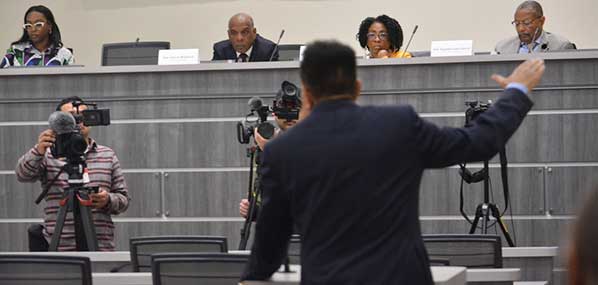
During that March 2022 meeting, the task force listened to the perspectives of 11 genealogy experts who offered insights on qualification for reparations before voting 5-4 in favor of eligibility.
One of the experts, Dr. Evelyn McDowell, an Associate Professor and Accounting Department Chair at Rider University in New Jersey, is a member and president of the Sons and Daughters of the United States Middle Passage (SDUSMP), a society that works to preserve the memory and history of slavery.
The 10-year-old organization, McDowell said, has successfully helped its members trace their lineage through a mix of research and analysis of the U.S Census, birth and death certificates, and state laws that tracked the enslaved.
“My purpose here is to tell the (task force) that it is absolutely possible to trace one’s lineage to individuals who were enslaved in the United States,” McDowell said. “For the vast majority of African Americans, it is relatively easy.”
Dr. Hollis Gentry, a genealogy specialist at the Smithsonian’s National Museum of African American History and Culture Library, shared personal experiences of tracing her ancestry to slavery. She used the Freedmen’s Bureau Records, national archives, and records from Daughters of the American Revolution (DAR).
Gentry suggested that an agency should be established to manage the eligibility process. It should be connected to state archives and offices of vital records to facilitate access to records that would assist reparations applicants.
Other genealogists who testified pointed to the lack of access to historical records and the difficulties created when enslaved families were separated after members were sold, traded, and auctioned.
Kellie Farrish, a genealogist with over 15 years of experience in Deoxyribonucleic acid (DNA) analysis and lineage tracing using DNA, provided instructions for how one might want to do genealogy research to locate “enslaved ancestors using the completely free Familysearch.com website.”
Farrish, the lead genealogist for the non-profit Reparation Generation, noted three criteria for determining potential reparations applicants’ lineage: ancestors born in the Deep South states prior to 1865, ancestors living in the U.S. prior to the 1900s, and ancestors living in the Deep South states prior to the Great Migration of the 1940s.
“First, we must define what it means to be African American. For the sake of this discussion, African Americans are those involuntarily brough to the United States for the purpose of being enslaved,” Farrish told the task force. “Using genealogy to prove descendancy from this group would involve tracing one’s lineage back to either a person enslaved in this system or a time when there was little to no presence of legal voluntary immigration from African or Caribbean countries.”
In August 2022, Gov. Gavin Newsom signed Senate Bill (SB) 189, legislation that would facilitate processing lineage-based reparations claims using state data. SB 189 authorizes the State Controller’s Office and the Department of Human Resources to disaggregate Black employee demographic data in an effort to identify who has immigrant origins and who descends from enslaved people in the United States.
SB 189 was authored by the Coalition for a Just and Equitable California (CJEC) and Assemblymember Chris Holden (D-Pasadena). CJEC is a statewide coalition of organizations, associations and community members united for Reparations for Black U.S Slavery Descendants.
SB 189 “feels like a generational step forward for our people, for the state, and for the country,” Coalition for a Just and Equitable California (CJEC) lead organizer Chris Lodgson said after Newsom signed the bill. “We are a specific group of people, and we need and deserve to be recognized as such, for reparations and for everything else we are owed.”
The task force will hold its next meeting May 6 in Oakland at Lisser Hall, which is located at 500 MacArthur Boulevard, Mills College at Northeastern University. It will begin at 9 a.m. PT.

Leave a reply
You must be logged in to post a comment.