
Monterey Jazz Festival: Historic Homecoming
By Barbara Smith
Photos: Earl Edwards
For three remarkable days, the 69th Monterey Jazz Festival seemed to recapture something jazz lovers have been yearning for: the exhilarating experience of hearing extraordinary musicians speak to one another through their instruments, connecting generations through a musical language that never grows old.
The September 25–27 festival was especially historic, marking the centennial birthdays of two towering figures in jazz, Miles Davis and John Coltrane. Their musical legacies resonated throughout the weekend, not simply as tributes to the past but as inspiration for the artists carrying jazz into the future.
Friday evening set the tone as the Jazz at Lincoln Center Orchestra, under Wynton Marsalis, delivered a sparkling performance showcasing seasoned musicians and rising talent. Joining them was enchanting vocalist Cécile McLorin Salvant, shimmering in green chiffon, whose playful rendition of “Sentimental Journey” seemed a fitting invitation to come home to jazz.
Later, legendary bassist Ron Carter, 89, commanded the Ray Drummond West End Stage with his Foursight Quartet. Tall, slender and impeccably dressed, Carter led an uninterrupted musical journey that held the audience spellbound despite the chilly night air.
“It’s cold up here, but thank you for your warmth,” he told the crowd. His inventive interpretation of “You Are My Sunshine” transformed a simple melody into something extraordinary, his slender fingers gliding across the strings. For Inland Valley attendees, the newly named Ray Drummond West End Stage held special significance. A Claremont Colleges alum, bassist Drummond was a longtime Festival performer who also served as 1998 Artist-in-Residence. Naming the stage in his honor is a fitting tribute to this prolific artist who sadly passed away in 2025.
Saturday brought the blues roaring onto the Jimmy Lyons Arena Stage with Christone “Kingfish” Ingram and Friends. A protégé of blues legend Buddy Guy, Kingfish has clearly come into his own. Relaxed and brimming with soul, he traded fiery guitar riffs with his exuberant bandmates and special guest powerhouse vocalist Shemekia Copeland. The set was pure joy, steeped in blues tradition and spiced generously with funk.

Perhaps no performance more poignantly illustrated the connection between generations than saxophonist Ravi Coltrane’s centennial tribute to his father, John Coltrane. Opening with movements from A Love Supreme, Ravi and his quartet delivered imaginative interpretations of “Equinox,” “Naima” and other classics. Only two when his father died, the younger Coltrane honored a monumental musical legacy while speaking with a distinctive voice of his own.
Sunday morning brought an unforgettable discovery: blind pianist and vocalist Brittany Davis and Black Thunder. Davis commanded the Arena Stage with thunderous piano playing, powerful gospel-infused vocals and an irresistible spirit. “We’re all different, but we’re all the same,” she declared. Her songs challenged conventional notions of beauty and belonging, inviting listeners to look beyond appearances. From the Arena to her later standing-room-only performance in the Pacific Jazz Café, Davis’ Monterey debut offered a glimpse into a promising career unfolding.
The weekend also provided a platform for social commentary. Spoken-word artist aja monet delivered impassioned poetry addressing racial injustice, working-class struggles and global suffering, at one point lifting her voice through a glittering megaphone. Meshell Ndegeocello, presenting her American 250 commissioned work, explored the contradictions of American identity through layered electronics, soulful vocals and politically conscious lyrics. Both reminded audiences that jazz and its related traditions have long given voice to those seeking justice and change.
Among the weekend’s most transcendent moments was saxophonist Charles Lloyd’s return to Forest Flower, his landmark composition associated with Monterey six decades earlier. Joined by pianist Gerald Clayton, bassist Larry Grenadier and drummer Brian Blade, Lloyd, wearing his signature knit cap and dark glasses, offered a mesmerizing performance. Smiles passed among the musicians as the jazz visionary moved between tenor saxophone and flute, each instrument lending its voice to a musical conversation that needed no words. Indeed, none were spoken throughout the set. None were needed as the music spoke for itself.
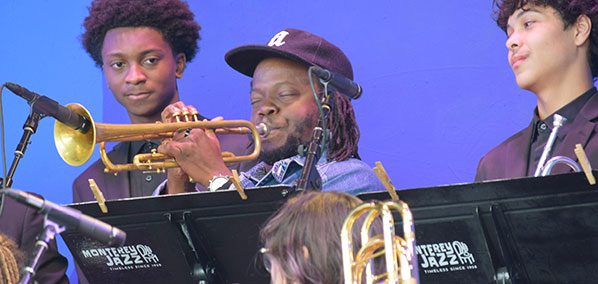
Sunday’s Next Generation Jazz Orchestra brought youthful exuberance to the Arena Stage with arrangements honoring Davis and Coltrane. Under Monterey’s Artistic Advisor, Gerald Clayton, the young musicians played with remarkable confidence and joy, joined by trumpeter Ambrose Akinmusire, himself a former NGJO member. It was a full-circle moment, demonstrating how Monterey’s investment in music education continues to bear fruit.
The historic weekend reached its eagerly awaited finale with the reunion of Herbie Hancock and Ron Carter, two iconic members of Miles Davis’s celebrated Second Great Quintet. Their interpretations of “Autumn Leaves” and “Walkin'” offered a rare opportunity to witness living history, their musical conversation as compelling as ever.
Since its founding in 1958, Monterey has welcomed generations of jazz greats. This year’s festival reaffirmed that its greatest gift may be more than preserving that extraordinary legacy. It is ensuring the music continues to grow, evolve and find new voices.
